AI-Generated Content vs Human-Written Content for Contractor Websites: What Google Actually Rewards
Every contractor who has tried to keep up with content marketing in the last two years has run into the same version of the same question. Does AI content work? Will it hurt my rankings? Is it worth paying someone to write it, or can I just generate it myself?
The question sounds simple. The answer is more specific than most of what gets written about it.
Google does not penalize content because it was written by an AI. That is the clear position in Google's official guidance on AI-generated content, updated through December 2025. What Google penalizes is content that is thin, generic, unoriginal, and created primarily to rank rather than to genuinely help the person reading it.
AI content fails that standard at scale not because of how it was produced, but because most of it is produced without the local knowledge, firsthand experience, and specific expertise that Google's systems are specifically designed to detect and reward.
For a plumber in Vancouver, a roofer in Royse City, or a tree service in Napa County, the question is not really AI vs human. The question is whether the content on the website reflects the specific knowledge of someone who does this work in that market, or whether it reflects a generic output that could apply to any contractor in any city in the country.
That distinction is what determines whether content ranks, earns trust, and converts calls.

What Google's E-E-A-T Standard Actually Means for a Service Business
Google's content quality framework is built around four signals: Experience, Expertise, Authoritativeness, and Trustworthiness. The framework is called E-E-A-T, and according to Google's Search Central documentation, it is the evaluative lens Google's systems apply to every piece of content, regardless of how it was produced.
For a national brand with a recognizable name, authoritativeness is relatively easy to signal. For a locally owned roofing company in Guilford, Connecticut, or a tree service in Johnson County, Texas, those signals have to come from the content itself.
The writing has to demonstrate that the person behind it knows what northwest Connecticut's freeze-thaw cycle does to roof flashing, or what North Texas drought stress does to a mature oak's root system. Generic national content does not carry those signals because it cannot. It was not written with that knowledge.
| E-E-A-T Signal | Generic AI content | Expert local content |
|---|---|---|
| Experience | No firsthand detail | References real local conditions |
| Expertise | Broad, anyone could write it | Specific technical detail from the trade |
| Authoritativeness | Could be any company anywhere | Named local context and credentials |
| Trustworthiness | Generic claims, no sourcing | Accurate, verifiable, clearly sourced |
The March 2026 core update specifically reinforced these quality signals. According to Google Search Central's creating helpful content guidance, content should be evaluated on who created it, how it was produced, and most importantly why.
Content created primarily to attract search engine traffic rather than to genuinely help the reader is what the helpful content system is designed to identify and suppress, whether it was written by AI or by a human.
Why Generic AI Content Fails for Contractor Websites Specifically
The performance problem with generic AI content on a contractor website is structural, not stylistic.
A plumbing company in Gainesville, Florida competes for search visibility in Alachua County, not nationally. The homeowner searching for a plumber at 9pm is looking for someone who knows the Floridan Aquifer, knows what hard water does to pipe systems in that climate, and knows the neighborhoods they serve. A generic AI article about plumbing that could have been published by anyone in any city provides none of that signal.
Google's systems have become substantially more capable of detecting this absence. Pages with local-specific detail, first-person professional knowledge, and content that directly addresses the specific problems of a defined geographic market outperform generic pages on the same keywords at a measurable rate.
iGotU Media has observed this pattern directly across client work in multiple markets and industries.
The failure pattern for contractors who publish generic AI content follows a consistent timeline:
| Stage | What happens |
|---|---|
| Content published | Pages indexed, modest early traffic |
| 30 to 90 days | Rankings slip against local competitors |
| Core update cycle | Generic pages drop as quality systems recalibrate |
| 6 to 12 months | Traffic plateaus, no authority built |
| Outcome | Volume produced, no leads generated |
This is the specific trap that causes contractors to conclude that content marketing does not work. The content did not work. The approach behind it did not reflect real expertise in a real market. That is not an AI problem or a human-writing problem. It is a strategy problem.
What Google Actually Rewards: The Contractor Content Standard That Performs
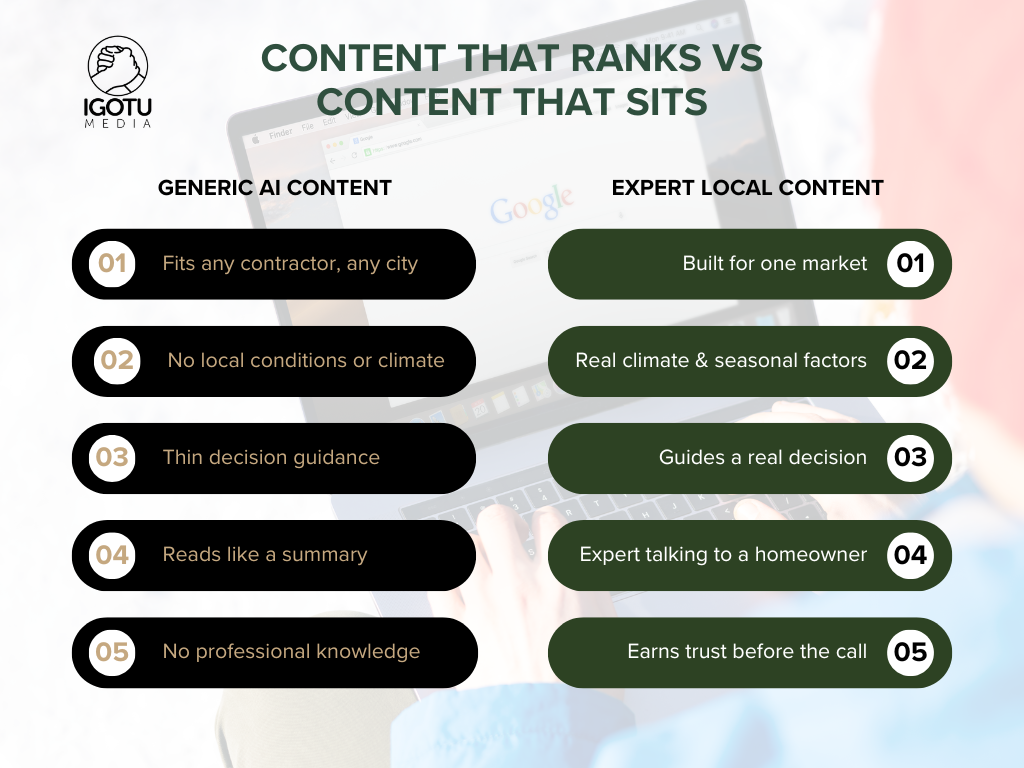
The content that earns and holds rankings on contractor websites in 2026 shares a consistent set of characteristics that are independent of whether AI was involved in its production:
- Answers a specific local question. Not "what is a French drain" but why French drains in Clinton, Connecticut need to sit below the 36-inch frost line. Specificity is the signal Google reads as real knowledge.
- Reflects the service area's real conditions. Nor'easters and salt air for a CT Shoreline roofer. The Floridan Aquifer for a Gainesville plumber. Local accuracy is a quality signal generic content cannot fake.
- Guides a real decision. Repair or replace. Wait or call now. What homeowners consistently get wrong. This comes from doing the work, not from a keyword brief.
- Reads like an expert, not a draft. No restated questions, no filler bullets, no summary-style transitions. Google's systems recognize those patterns at scale, and the March 2026 core update sharpened that capability.
The Right Way to Use AI in Contractor Content
The position that AI is the enemy of good contractor content is as wrong as the position that AI alone can produce it effectively. AI used correctly reduces the time and effort required to produce quality content. AI used incorrectly produces volume without value.
iGotU Media's approach to contractor content treats AI as a production tool, not a strategy tool. The strategy, the local knowledge, the specific market context, and the professional expertise that makes content worth reading are all human inputs. The writing that reflects those inputs is produced with efficiency tools where they genuinely help the process.
What AI cannot do on a contractor website is provide the specific professional observation that makes a blog valuable. What does a plumber in Clark County, Washington see in older homes from the 1970s in established Vancouver neighborhoods? What flashing failure pattern does a roofing company on the CT Shoreline encounter most consistently after a nor'easter? What soil condition in Harris County, Texas is the specific reason a post-storm root plate failure is so much more common there than in drier markets?
That knowledge does not exist in any AI training dataset in the form that serves a specific local market. It exists in the experience of the contractor and the team that works with that contractor to translate experience into content. That translation process is what produces content that ranks, builds authority, and earns the trust of homeowners who are deciding who to call.
For contractors who want to understand what a content strategy built on this standard looks like in practice, iGotU Media's
content creation and strategy service explains the approach and what it produces over time.
What This Means for a Contractor Evaluating Content Options Right Now
A contractor in 2026 evaluating content options is choosing between three practical paths, each with a different performance outcome:
- Unedited AI content. Lowest cost, lowest performance. Early indexing, no authority, no meaningful conversions. The March 2026 core update shortened its shelf life significantly.
- Generic human-written content. A writer with no market knowledge and no contractor input produces the same problem as raw AI output. Different method, same result.
- Expert local content, however it is produced. Builds topical authority, holds rankings through core updates, and compounds over time. This is the pattern iGotU Media documents in its case study work: growing visibility, more qualified calls, improving return on every piece published.
The decision is not AI or human. The decision is whether the content reflects real knowledge of a real market. iGotU Media builds that standard into every piece of content the team produces for contractors, regardless of the production tools involved.
For a related look at how the visibility system that content feeds into works across search, AI Overviews, and GEO, the
iGotU Media article on how AI search and Google SGE are changing how contractors get found online explains the full picture of what content quality signals mean in 2026 and beyond.
Frequently Asked Questions
Does Google penalize AI-generated content on contractor websites?
No. Google's official position, stated in its Search Central documentation and reinforced through the March 2026 core update, is that content is evaluated on quality, helpfulness, and E-E-A-T signals, not on how it was produced. Generic, thin, or low-value content is penalized regardless of whether a human or an AI wrote it. High-quality content that demonstrates genuine expertise in a specific market performs well regardless of the tools used to produce it.
What is E-E-A-T and why does it matter for a plumber or roofer?
E-E-A-T stands for Experience, Expertise, Authoritativeness, and Trustworthiness. These are the quality signals Google's systems use to evaluate whether content deserves to rank. For a local contractor, these signals come primarily from the content itself: does it reflect real knowledge of the trade, the local market, and the specific problems homeowners in that area face? Generic content that could apply to any market in any city does not carry these signals. Local-specific, expertise-driven content does.
Can a contractor publish AI-generated content and still rank well?
Yes, but only if the content meets Google's quality standards. That means the content reflects genuine expertise and local knowledge, answers real questions homeowners in that market are asking, and reads like it was written by someone who actually does this work in that place. Most AI content published without expert input and local context does not meet that standard and does not perform accordingl
How is iGotU Media's content different from generic AI output?
The difference is in what drives the content before any writing begins. iGotU Media's content strategy for each contractor is built on the specific market conditions, common customer problems, local climate and soil factors, and professional expertise that is unique to each client's service area. That local and professional knowledge is what makes the content reflect genuine expertise. The production tools used to write it efficiently are secondary to the strategic and research inputs that give it value.
How long does it take for quality content to produce results on a contractor website?
Organic search results from quality content typically become visible within three to six months, with meaningful topical authority developing over six to twelve months of consistent publishing. The compounding pattern iGotU Media documents in client work shows that each additional piece of quality content reinforces the authority of the overall site rather than existing in isolation. A contractor who publishes consistently in a defined service area with locally-specific expertise-driven content builds a visibility position that is difficult for competitors publishing generic content to close.
Does iGotU Media use AI in producing contractor content?
iGotU Media uses production tools where they improve efficiency without reducing quality. The strategy, local market research, professional expertise inputs, and editorial review that determine whether content meets Google's quality standard are all human-driven processes. The content that publishes under a client's name reflects that client's expertise and their specific market, not a generic output from a keyword brief.
Whether you are a contractor who has tried content marketing without results, is evaluating AI tools to handle it yourself, or is looking for a partner who builds content that reflects genuine expertise in your specific market, iGotU Media's approach is built around exactly that standard.

Simple steps. Big results.
Contact Us Form
We will get back to you as soon as possible.
Please try again later.
More Post Like This:



Level Up Your Online Strategy
Whether you're running a service business along the Beeline Highway, trying to get found during tourist season, or just tired of watching competitors outrank you in Show Low or Heber, this is where that changes. Book a free consultation with iGotU Media. No pressure, no jargon, no 90-minute sales pitch. Just an honest conversation about where your business stands and what it would take to get found.