Why Every Business Needs a Content Strategy — And What Happens Without One
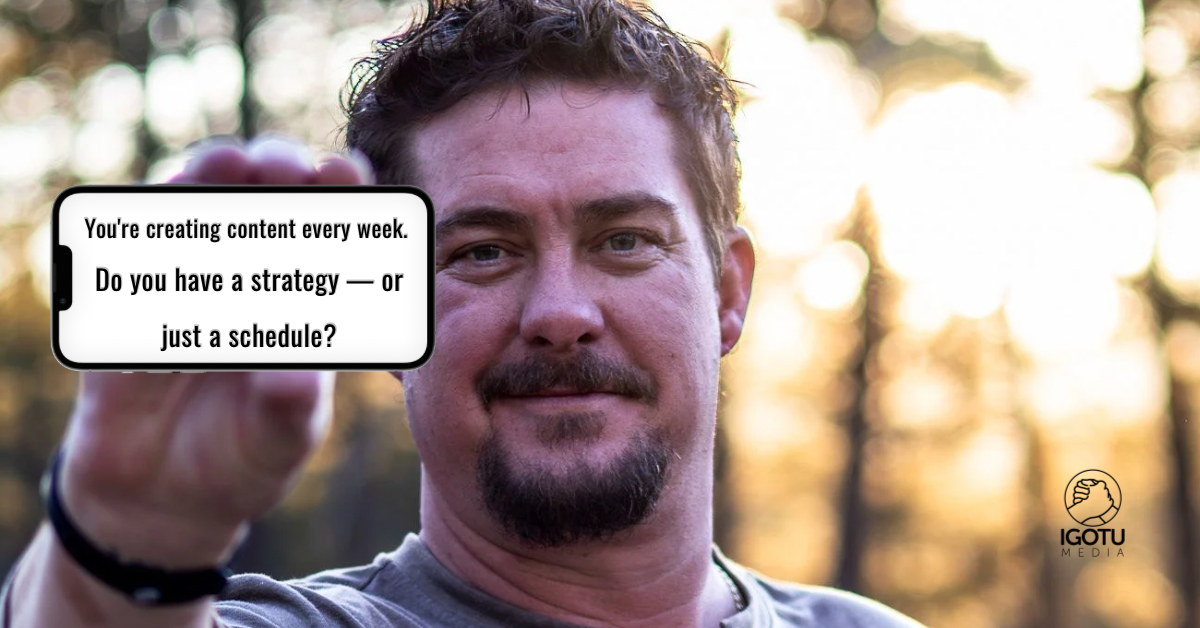
Most small businesses have content. Very few have a content strategy. The difference between those two things isn't sophistication or budget — it's the difference between content that compounds over time and content that disappears 48 hours after it's posted. A content strategy isn't a complicated corporate document. It's the framework that makes every piece of content intentional — connecting your blog to your GBP, your GBP to your social, and all of it to a clear business outcome. At iGotU Media, we build content strategies for small businesses because we've seen what happens when businesses create without one. This guide explains exactly what a content strategy is, what the four failure modes of creating without one look like, and how to build a system that actually compounds.
What Is a Content Strategy — And What It Isn't
Before building one, it helps to be clear about what a content strategy actually is — because most small business owners confuse it with something tactical.
What a content strategy IS:
- The framework that defines why you're creating content, who it's for, and what it needs to accomplish
- The system that connects your goals to your content decisions — so every blog, post, and video has a job
- The structure that turns scattered content efforts into a compounding, interconnected asset
What a content strategy IS NOT:
| Commonly Confused With | Why It's Different |
|---|---|
| A content calendar | A calendar tells you when to post. Strategy tells you what to post and why |
| A topic list or keyword plan | These are tactical outputs of a strategy — not the strategy itself |
| Posting frequently | Volume without purpose creates noise. Strategy creates authority |
| A one-time plan document | A real strategy is a living system — maintained, measured, and adjusted over time |
Without strategy, content creation leads to what could be called "execution debt" — the accumulation of scattered posts that individually cost time and money but collectively build nothing. With strategy, every piece of content contributes to a larger structure that gets more valuable over time.
What Happens When Small Businesses Create Content Without a Strategy
This is where most small business owners recognize themselves — and where the real cost of no strategy becomes visible:
Failure Mode 1 — Random posting: the post-and-hope trap You post when inspiration strikes or when you feel guilty about not posting. The content is disconnected, the voice is inconsistent, and the algorithm ignores sporadic activity. You spend hours creating something that gets seen by almost no one — and you have no idea whether the handful of people who did see it were your actual customers or just random followers who will never buy.
Failure Mode 2 — No SEO foundation: the hidden store problem You write content based on what feels relevant rather than what your customers are actually searching for. A well-written blog post that nobody searches for is like a store on a street with no traffic — it exists, but it doesn't work. Meanwhile, competitors who do align their content with real search intent are capturing the leads you should be getting.
Failure Mode 3 — No audience targeting: the everyone-is-no-one trap Trying to appeal to everyone produces content that resonates with no one. Generic content that doesn't speak to a specific person's specific problem doesn't create connection, doesn't drive engagement, and doesn't convert — regardless of how well it's written.
Failure Mode 4 — No measurement: the blindfolded approach You don't know if your content is working because you're not tracking the right metrics — or not tracking at all. Vanity metrics like likes and follower counts feel good but don't connect to business outcomes. Without measurement, you can't optimize, can't justify the investment, and can't identify what's actually driving results vs. what's wasting time.
✏️
Each failure mode named and described in plain language — relatable and personal without being preachy. This section is where the reader recognizes themselves before reading the solution.
The Five Elements Every Small Business Content Strategy Needs
A content strategy doesn't have to be complicated to be effective. Every small business content strategy needs exactly five things:
1. Measurable goals — the why What is the content supposed to accomplish? Not "brand awareness" as a vague concept — but specific, measurable outcomes. Generate 10 qualified leads per month. Rank for five local service keywords. Drive 500 monthly visits to the service page. Goals are what make content decisions intentional rather than arbitrary.
2. Target audience — the who Not "homeowners" or "small business owners" — but a specific person with specific problems, specific questions, and specific objections. The more precisely you define who you're writing for, the more your content resonates with the people most likely to become customers.
3. Topic clusters — the what Core service themes that you want to be known for — each one becoming a hub with related supporting content that builds topical authority over time. A plumber in Gainesville builds a cluster around "Plumbing Services Gainesville FL." Every related blog post connects back to that hub and reinforces the whole cluster's search authority.
4. Channels — the where Not every platform. The platforms where your specific audience actually spends time. A local tree service company in Cleburne TX doesn't need a TikTok strategy — they need a strong blog, an optimized GBP, and consistent Facebook content that their neighbors see and share.
5. Measurement — the how do you know it's working Tracking conversions and leads — not just likes and impressions. What content is driving calls? What blogs are ranking? What GBP posts are generating clicks to the website? Measurement is what turns content from a cost into an investment that gets smarter over time.
How a Content Strategy Connects Every Platform You're On
This is where a content strategy stops being a document and becomes a system. Here's how each platform connects when strategy drives the decisions:
Blog — the foundation Every blog post answers a specific question your customers are already asking. It ranks in search, builds topical authority, and creates the raw material that feeds every other platform. Without a strong blog foundation, the other platforms are generating content into a void.
Google Business Profile — the local conversion engine GBP posts extracted from the week's blog content signal to Google that the business is active while driving calls and direction requests from local searchers. A blog about drain cleaning in Gainesville FL becomes three GBP posts — educational, urgency, promotional — that reach local customers at their highest-intent moment.
Social media — the reach extender Short-form posts, captions, and graphics adapted from the blog reach audiences who aren't actively searching. Social doesn't replace search — it extends the reach of content that's already working, bringing new people into the top of the funnel.
Email — the relationship nurturer The email list is the only audience a small business actually owns — not subject to algorithm changes or platform policy shifts. A weekly email newsletter built from the blog's key insights nurtures existing relationships and drives consistent traffic back to content that's already ranking.
The compounding workflow: Publish blog → Extract 3 GBP posts → Write Facebook caption → Create Canva graphic → Send email newsletter → Outline short-form video script → Repeat next week
Each week's output feeds from a single source. Each platform reinforces the others. Over 12 months the compounding effect becomes significant — and the cost per lead drops as the asset base grows. For the complete step-by-step guide to executing this workflow,
read our
repurposing guide — how to turn one blog into 10 pieces of content →
Content Strategy vs. Content Creation — The Difference That Changes Everything
Most small businesses have content creation. Almost none have strategy. This distinction explains why some businesses compound and others plateau regardless of how much content they produce.
Content creation is the output — the blog post, the social caption, the GBP update. It's visible, tangible, and feels productive. It's also just noise without direction.
Content strategy is the blueprint — the framework that makes every piece of content intentional, connected, and measurable. It determines what gets created, why, for whom, on which platform, and how success is defined.
| Content Creation Without Strategy | Content Creation With Strategy | |
|---|---|---|
| Approach | Reactive — create when inspired | Proactive — create from a plan |
| Result | Scattered, inconsistent, hard to measure | Cohesive, compounding, trackable |
| Value over time | Flat — each piece stands alone | Exponential — each piece builds on the last |
| Audience connection | Sporadic — who sees it is random | Intentional — reaches the right person at the right moment |
| Business impact | Unpredictable | Measurable and improvable |
The businesses winning at local SEO and content marketing aren't necessarily creating more content than their competitors. They're creating smarter content — with a strategy that makes every piece work harder and last longer. For a deeper understanding of how to build content that works long after it's published,
read our evergreen content guide for small businesses →
How Long Does It Take to See Results From a Content Strategy?
This is the question every small business owner asks before committing — and the honest answer is: longer than most agencies will tell you, and shorter than most business owners fear.
| Phase | Timeline | What to Expect |
|---|---|---|
| Foundation | Months 1–3 | Low traffic but increasing indexation. Search engines begin understanding your site's relevance. Early leading indicators — impressions, social shares — start improving |
| Traction | Months 4–6 | Noticeable ranking improvements for lower-competition keywords. Consistent traffic spikes begin. Brand recognition starts building in the local market |
| Momentum | Months 7–9 | High-performing content begins converting traffic into leads. More predictable traffic patterns. Domain authority building from consistent quality content |
| ROI and compounding | Months 10–12 | Content published months ago reaches peak ranking positions. Cost per lead drops as the asset base grows. The compounding effect becomes clearly measurable |
What accelerates results:
- Domain authority — established websites see faster results than brand new ones
- Publishing consistency — businesses that publish weekly see results significantly faster than those publishing monthly
- Content quality — one genuinely useful, well-optimized blog outperforms ten thin posts every time
- Integration — businesses that connect blog, GBP, social, and email compound faster than those running channels in isolation
The honest expectation: A content strategy is a 12-month investment with compounding returns — not a 30-day marketing campaign with a clear end date. The businesses that commit to it consistently are the ones that eventually dominate their local markets in search.
The iGotU Media Content Strategy Framework for Small Businesses
Every content strategy iGotU Media builds for a small business is built on three integrated systems — and they work together in a specific sequence:
The Strategic 4 content pillars Every piece of content we create falls into one of four categories: Education (how-to guides, FAQs, explainers that build trust before the sale), Authority (deep-dive expertise that establishes topical credibility), Social Proof (results, case studies, and testimonials that validate the promise), and Community (local connection content that builds relationships beyond transactions). The mix of these four pillars is what prevents content from becoming either all-promotional or all-informational — both of which underperform.
Topic cluster architecture We build every client's content around a topic cluster structure — a pillar page representing the core service, surrounded by spoke blogs that each target a related search query and link back to the pillar. This is how a Gainesville plumber becomes the authoritative resource for all plumbing searches in their market over time — not by publishing randomly, but by systematically building a connected network of content that Google recognizes as expertise. For a practical example of how this works, read our guide on how blogs improve Google rankings month after month →
The repurposing system Every blog we publish becomes GBP posts, social captions, Canva graphics, email content, and video scripts — automatically, within the same weekly workflow. No content is created once and abandoned. Every piece has multiple distribution paths, and every distribution path drives traffic back to the original asset. This is what makes the system sustainable — one core creation effort multiplying across every platform the client is active on.
How to Get Started With a Content Strategy for Your Business
The most common reason small businesses don't have a content strategy isn't budget or time — it's not knowing where to start. Here's the honest starting point:
Step 1 — Define one specific business goal for your content Not "grow my social media" — but "generate 5 qualified calls per month from organic search." A specific goal creates a filter for every content decision that follows.
Step 2 — Identify your three most valuable customer questions What do your best customers ask before hiring you? What do people search before finding your service? Those questions are your first three blog topics.
Step 3 — Pick your three primary channels Blog, GBP, and one social platform is enough to start. Doing three things consistently beats doing seven things sporadically every time.
Step 4 — Commit to a publishing cadence and protect it One blog per week. Three GBP posts per week. One social post per week. Put it in the calendar as a non-negotiable business activity — not something you do when you have time.
Step 5 — Measure one metric that connects to revenue Not likes. Not followers. How many calls came from organic search this month? How many people clicked from GBP to the website? Track one metric that connects content activity to business outcome.
If you want the done-for-you version of this system — where the strategy, the writing, the GBP posts, the graphics, and the repurposing all happen without requiring your time — that's exactly what iGotU Media builds. Let's talk.

Simple steps. Big results.
Contact Us Form
We will get back to you as soon as possible.
Please try again later.
More Post Like This:



Level Up Your Online Strategy
Whether you're running a service business along the Beeline Highway, trying to get found during tourist season, or just tired of watching competitors outrank you in Show Low or Heber, this is where that changes. Book a free consultation with iGotU Media. No pressure, no jargon, no 90-minute sales pitch. Just an honest conversation about where your business stands and what it would take to get found.