DIY vs Professional Contractor Websites: What the Difference Actually Costs
Introduction
Every contractor who built their own website on Wix, Squarespace, or GoDaddy made a reasonable decision at the time. It was fast, it was cheap, and it produced something that looked like a website. The problem isn't that DIY website builders don't work. It's that they don't work the way a contractor's website needs to work — capturing local search traffic, converting visitors into callers, and building the SEO authority that compounds over time. The real cost of a DIY contractor website isn't the monthly subscription fee. It's the leads that never came in because the site couldn't rank, couldn't convert, and couldn't compete with the professional websites that owned the local searches your customers were making. iGotU Media builds professional websites and SEO content systems for contractors and home service businesses nationally. This guide breaks down what DIY website builders actually cost a service business — and what a professional contractor website delivers that a template never can.
What DIY Website Builders Are Designed to Do — And What They're Not Designed For
Wix, Squarespace, GoDaddy, and similar platforms are built for one purpose: making it easy for anyone to put something on the internet quickly. They accomplish that goal. They are genuinely easy to use, they produce visually acceptable results, and they cost very little to launch.
What they are not built for — and what their marketing doesn't mention — is competing in local search for high-intent commercial keywords in a competitive service market.
What DIY builders do well:
- Fast launch with minimal technical knowledge required
- Decent visual presentation on desktop and mobile
- Low upfront cost
- Basic contact forms and page structure
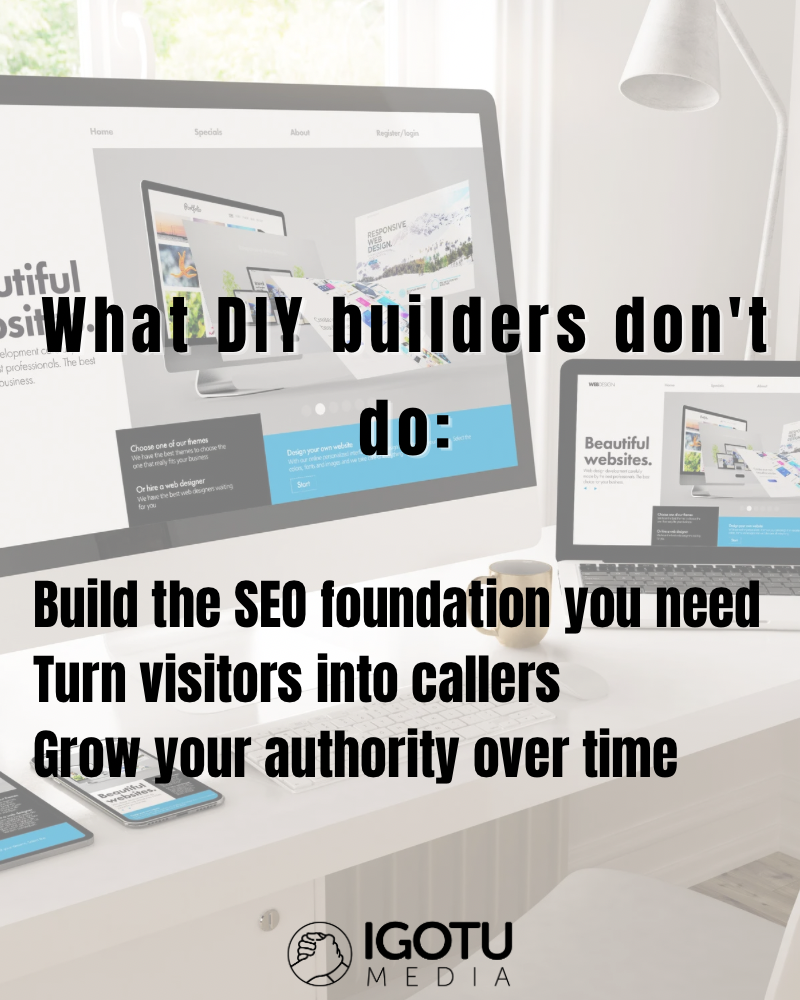
What DIY builders don't do:
- Generate the technical SEO foundation that local search ranking requires
- Produce the content architecture that builds topical authority over time
- Create the conversion-optimized page structure that turns visitors into callers
- Integrate with local SEO signals in the way Google's local algorithm evaluates and rewards
The business that built its own website has a digital presence. The business with a professionally built contractor website has a lead generation system. These are different things — and the difference shows up in search rankings, call volume, and revenue every single month.
The Technical SEO Gap That DIY Builders Create
A contractor website that can't be found in search is a brochure that no one picks up. The technical foundation that determines whether Google can find, index, and rank your website is where DIY builders fall furthest short:
Site speed and Core Web Vitals
Google uses page loading speed as a ranking factor — and DIY builder sites are consistently slower than professionally built contractor websites due to bloated code, unoptimized images, and platform-level overhead that the contractor has no ability to control. A site that loads in 4 seconds loses ranking ground to a site that loads in 1.5 seconds — all else being equal.
Schema markup
Schema is structured data that tells Google exactly what your business is, where it's located, what services you offer, and how to display your information in search results. LocalBusiness schema, Service schema, and Review schema all contribute to local search visibility. DIY builders either don't support proper schema implementation or implement it incorrectly. A professionally built contractor website has schema built in correctly from day one.
URL structure and site architecture
Google crawls websites hierarchically — it evaluates how pages relate to each other and assigns authority accordingly. DIY builders typically produce flat, unstructured URL patterns that don't signal the service-location hierarchy that local search ranking rewards. A professional contractor website is built with URL structures, internal linking, and site architecture designed specifically for local service business SEO.
Mobile optimization beyond responsive design
Responsive design — content that reflows on smaller screens — is the baseline. It's not the same as mobile optimization. Conversion-optimized mobile experience for a contractor website means click-to-call buttons that are thumb-accessible, contact forms that don't require zooming, and page structures that put the most conversion-critical elements above the fold on a phone screen. DIY templates are responsive. Professional contractor websites are mobile-conversion optimized.
Hosting and uptime
DIY platforms use shared hosting environments that can't be optimized for your specific site's performance requirements. Professional contractor websites are hosted on infrastructure selected for speed, security, and reliability — because a site that's down during a storm emergency isn't generating the call that emergency would have produced.
The Content Architecture Gap
A contractor website that exists but doesn't publish content relevant to what customers are searching for doesn't rank — regardless of how well it's built technically. This is where the long-term cost of a DIY website becomes most significant:
Service pages vs. landing pages
A DIY contractor website typically has a handful of general service pages: "Plumbing," "Water Heaters," "Drain Cleaning." These pages exist but don't rank competitively because they're not built around the specific local search queries customers are actually using.
A professional contractor website is built with location-specific service landing pages targeting the actual search terms: "Water Heater Repair Gainesville FL," "Drain Cleaning Yacolt WA," "Roof Inspection Royse City TX." Each page is built around one specific search intent, one specific location, and one specific conversion goal.
The blog and topic cluster gap
The businesses that dominate local search in any service category aren't just ranking on their service pages. They're ranking on 20, 30, 50 blog posts that capture the informational and commercial investigation searches that happen before someone calls a contractor. A DIY website with no content strategy is competing against a professional website with a full topic cluster — and losing that competition every month.
Internal linking architecture
Every piece of content on a professional contractor website is connected to every other relevant piece through strategic internal linking. This distributes authority across the site, strengthens the pages competing for the most valuable keywords, and guides visitors from informational content toward service pages and contact forms. DIY websites have internal linking by accident. Professional contractor websites have internal linking by design.
The Conversion Gap — Traffic That Doesn't Call
A contractor website can rank in search and still fail to generate leads if it isn't built to convert visitors into callers. This is the second major gap between DIY builder sites and professional contractor websites:
Above-the-fold conversion architecture
The first thing a visitor sees on your website — before they scroll — determines whether they call or leave. On a professionally built contractor website, the above-the-fold section on every service page includes: a clear statement of what you do and where, a visible phone number that's click-to-call on mobile, social proof in the form of review count or rating, and a primary CTA. On a typical DIY builder site, the above-the-fold section is a hero image and a tagline.
Trust signals placed strategically
Licenses, certifications, insurance, review ratings, years in business, and service area confirmation are the trust signals that convert a website visitor into a caller. On a professional contractor website, these are placed at the specific decision points in the page where visitors are evaluating whether to call — not buried in the footer or the About page.
Call tracking and conversion measurement
You can't improve what you can't measure. A professionally built contractor website integrates call tracking, form submission tracking, and Google Analytics conversion goals that tell you exactly which pages, which keywords, and which traffic sources are producing calls. DIY builder analytics tell you how many people visited your site. Professional contractor website analytics tell you how many people called — and why.
CTA architecture throughout the site
Every service page, every blog post, and every location page on a professional contractor website ends with a specific, relevant call to action that matches what the reader just learned. A blog about hail damage roof repair ends with "Schedule your free Swift Roofing inspection." A DIY site's CTA is typically a generic "Contact us" link in the navigation — which most visitors never click.
The Local SEO Gap — What Google Actually Evaluates
Local search ranking — the Google Maps pack and the local organic results that drive the majority of contractor calls — is determined by factors that DIY websites can't effectively influence:
Google Business Profile integration
A professional contractor website is built with consistent NAP (Name, Address, Phone) information that matches the Google Business Profile exactly — at the footer, on the contact page, and in the schema markup. Inconsistencies between the website and GBP create trust signal conflicts that reduce local pack ranking. DIY websites frequently have inconsistent formatting that creates these conflicts without the owner knowing.
Location page architecture
Contractors serving multiple cities need dedicated location pages for each service area — each page targeting the specific city-level search queries for that geography. "Roofing Contractor Royse City TX," "Roofing Contractor Rockwall TX," "Roofing Contractor Sachse TX." DIY builders produce generic location pages that don't differentiate enough between service area geographies to rank in each market. Professional contractor websites build location page architecture that captures each city's local searches independently.
Review signal integration
Review count, recency, and star rating displayed on the website — pulled from Google — reinforce the social proof and trust signals that convert visitors while simultaneously reinforcing local SEO authority signals. Professional contractor websites integrate review feeds and display review counts dynamically. DIY sites display static testimonials that don't update and don't signal the same authority.
The Real Cost Comparison — What You're Actually Paying
| DIY Website Builder | Professional Contractor Website | |
|---|---|---|
| Monthly cost | $20–$50/month | $150–$500/month depending on scope |
| Setup time | 10 to 40 hours of owner time | Handled by the agency |
| Technical SEO | Partial — platform limitations | Complete — built to rank |
| Content architecture | None built in | Service pages, location pages, blog system |
| Conversion optimization | Template defaults | Built around your specific conversion goals |
| Local SEO integration | Basic | Schema, NAP consistency, location architecture |
| Monthly leads from organic search | Low to none for competitive keywords | Compounds over 6 to 12 months |
| True monthly cost | $20–$50 + owner time + opportunity cost of missed leads | Investment with measurable ROI |
The opportunity cost calculation:
A contractor who closes a job at $3,000 average ticket and could be generating 3 to 5 additional organic search leads per month from a professional website and content strategy is leaving $9,000 to $15,000 in potential monthly revenue on the table — for a website investment that costs a fraction of one job.
The question isn't whether a professional contractor website costs more than a DIY builder. It does. The question is whether the difference in lead generation justifies the difference in investment. For virtually every service contractor in a competitive local market — the answer is yes, and the ROI timeline is typically 3 to 6 months.
What a Professional Contractor Website From iGotU Media Actually Includes
Most web design agencies build websites. iGotU Media builds lead generation systems for contractors — with the SEO architecture, content strategy, and local search integration built in from the first page:
What every iGotU contractor website includes:
| Component | What It Does |
|---|---|
| Technical SEO foundation | Site speed optimization, schema markup, URL architecture, mobile conversion optimization |
| Service page architecture | Location-specific service pages targeting real local search queries |
| Google Business Profile integration | NAP consistency, schema alignment, review feed integration |
| Conversion-optimized page structure | Above-the-fold CTA, trust signal placement, click-to-call mobile optimization |
| Content strategy and topic cluster | Blog system built around the customer search queries that generate calls |
| Call tracking and analytics | Measuring which pages and keywords produce calls — not just traffic |
| Location page system | Service area pages for every city in your market |
| Ongoing content production | Weekly blogs that build topical authority and compound organic search rankings over time |
A website without a content strategy ranks for a handful of keywords and plateaus. A professional contractor website with an ongoing content strategy compounds — ranking for more searches every month, generating more leads every quarter, building an authority position that competitors can't replicate overnight.
For more on the content strategy that drives contractor lead generation, read our blog strategy that brings leads guide →. For the local SEO signals that complete the picture, read our Google Business Profile optimization guide →.
Ready to replace your DIY website with a lead generation system? Contact iGotU Media to discuss what a professional contractor website looks like for your specific business and market.

Simple steps. Big results.
Contact Us Form
We will get back to you as soon as possible.
Please try again later.
More Post Like This:



Level Up Your Online Strategy
Whether you're running a service business along the Beeline Highway, trying to get found during tourist season, or just tired of watching competitors outrank you in Show Low or Heber, this is where that changes. Book a free consultation with iGotU Media. No pressure, no jargon, no 90-minute sales pitch. Just an honest conversation about where your business stands and what it would take to get found.