
The Difference Between Brand Content & SEO Content
Most small business owners treat all content the same — write something, post it, hope it works. But brand content and SEO content serve completely different purposes, reach different audiences, and succeed by entirely different measures. Confusing the two — or worse, ignoring one completely — is one of the most common and costly content mistakes small businesses make. At iGotU Media, we build both intentionally, because a business that can't be found online loses to one that can, and a business with no brand voice loses the sale even when it does get found. This guide breaks down exactly what each type of content does, how they work together, and what that looks like for real Arizona service businesses.
What Is Brand Content — And What Is It Actually For?
Brand content is strategic storytelling that embeds a company's values, voice, and personality into everything it publishes — videos, blog posts, social media, emails — to build emotional connection, trust, and recognition over time. Unlike direct-response advertising, brand content isn't trying to make an immediate sale. It's building the kind of reputation that makes the sale easier when the moment comes.
What brand content actually does for your business:
| Brand Content Goal | What It Looks Like in Practice |
|---|---|
| Builds emotional connection | Focuses on why you do what you do — not just what you sell |
| Establishes trust and credibility | Positions your business as a reliable expert rather than just another vendor |
| Differentiates from competitors | Creates a consistent voice and visual identity that makes you memorable |
| Humanizes the brand | Shares stories that turn one-time customers into loyal advocates |
Brand content is what keeps people coming back — and what makes them refer you without being asked.
What Is SEO Content — And How Does It Work?
SEO content is strategic material — blogs, service pages, local guides — created specifically to rank in search engines for queries your potential customers are already typing. For Arizona service businesses, it works by targeting local keywords, answering specific customer questions, and building the kind of topical authority that signals to Google: this is the most relevant result for this search.
The most common types of SEO content for service businesses:
- Service pages — dedicated pages for each service optimized to drive calls and form fills (e.g., "Emergency Roof Repair Scottsdale AZ")
- Local SEO blog posts — articles targeting specific local questions (e.g., "Best time to aerate your lawn in Chandler AZ")
- FAQ and how-to content — structured answers to questions your customers ask before they call
- Case studies and reviews — credibility builders that improve conversion rates on high-intent pages
SEO content is what gets you found. Brand content is what gets you hired. Both are necessary — and neither works as well alone.
The Core Difference: Who Finds It and How
| Feature | Brand Content | SEO Content |
|---|---|---|
| Audience | Existing followers, past customers, warm leads | Potential customers actively searching for solutions |
| How they find it | Social media, email, word of mouth, direct | Google search, AI Overviews, local search results |
| Primary purpose | Build awareness, trust, and emotional connection | Capture search demand and drive targeted traffic |
| Focus | Storytelling, values, personality, consistency | Keyword research, user intent, technical quality |
| How success is measured | Conversion rate, shares, reviews, referrals | Organic traffic, rankings, click-through rate |
| Typical formats | Videos, brand stories, behind-the-scenes, team posts | Blog posts, service pages, local guides, FAQs |
The simplest way to think about it: brand content answers
"Why should I trust you?" SEO content answers
"Can I even find you?" Both questions need answering before anyone picks up the phone.
Why Treating Them the Same Hurts Both
This is where most small businesses go wrong in one of two directions:
Too much brand, not enough SEO: A beautifully written blog post with a great brand voice but no keyword strategy, no search intent match, and no local optimization. It resonates with people who already follow you — and no one else ever finds it.
Too much SEO, not enough brand: A keyword-dense service page or blog post that ranks but reads like it was written for a robot. It gets clicks but doesn't convert, because nothing about it builds the trust that turns a visitor into a customer.
The fix is intentional balance — not a compromise between the two:
In a competitive local market, your content needs to do both jobs simultaneously. Here's how that works in practice:
- Keywords placed naturally — in titles, meta descriptions, and woven into content that reads like it was written for a human, not an algorithm
- User intent first — structure every piece of content around what the reader actually wants to know, not just what you want to say
- Consistent voice across both types — SEO content should still sound like your brand, and brand content should still be findable
Examples of Brand Content vs. SEO Content for Small Businesses
Here's what the distinction looks like in practice across three industries common to iGotU Media's client base:
Roofing — Scottsdale / Phoenix
| Type | Example |
|---|---|
| SEO Content | Blog post: "Top 5 Signs You Need Roof Repair in Scottsdale After a Monsoon" — keyword-rich, local references, clear CTA for free estimate |
| Brand Content | Instagram video: Before-and-after of a tile roof repair in Gainey Ranch with a quick interview with the foreman on protecting tile roofs from Arizona sun |
Plumbing — Tucson / Phoenix
| Type | Example |
|---|---|
| SEO Content | Service page: "Emergency Plumbing Services Phoenix" — lists services, local phone number, targets high-intent searches |
| Brand Content | Blog or Facebook post: "How to Winterize Your Tucson Vacation Home Pipes" — showcases local knowledge and proactive expertise |
Lawn Care & Landscaping — Chandler / Gilbert
| Type | Example |
|---|---|
| SEO Content | Landing page: "Lawn Care Maintenance Chandler AZ" — covers aeration, sprinkler repair, weed control, optimized for local search |
| Brand Content | Blog guide: "Best Desert-Friendly Plants for Gilbert Homes" — shares local expertise rather than selling services directly |
Notice the pattern: SEO content tells Google what you do and where. Brand content shows customers why you're the one to call.
How the Strategic 4 Connects Both
At iGotU Media, we built the Strategic 4 framework specifically because small business owners shouldn't have to choose between being found and being trusted. Here's how each pillar serves both purposes simultaneously:
| Strategic 4 Pillar | Brand Content Role | SEO Content Role |
|---|---|---|
| Education | Positions you as the go-to expert in your field | Targets informational search queries your customers are asking |
| Authority | Showcases credentials, experience, and process | Builds E-E-A-T signals that Google uses to evaluate trustworthiness |
| Social Proof | Turns customer stories into brand advocates | Review content and case studies improve conversion on high-intent pages |
| Community | Humanizes your brand and builds local connection | Local references and community content strengthen local SEO signals |
How iGotU Media Builds Both Into One Cohesive Strategy
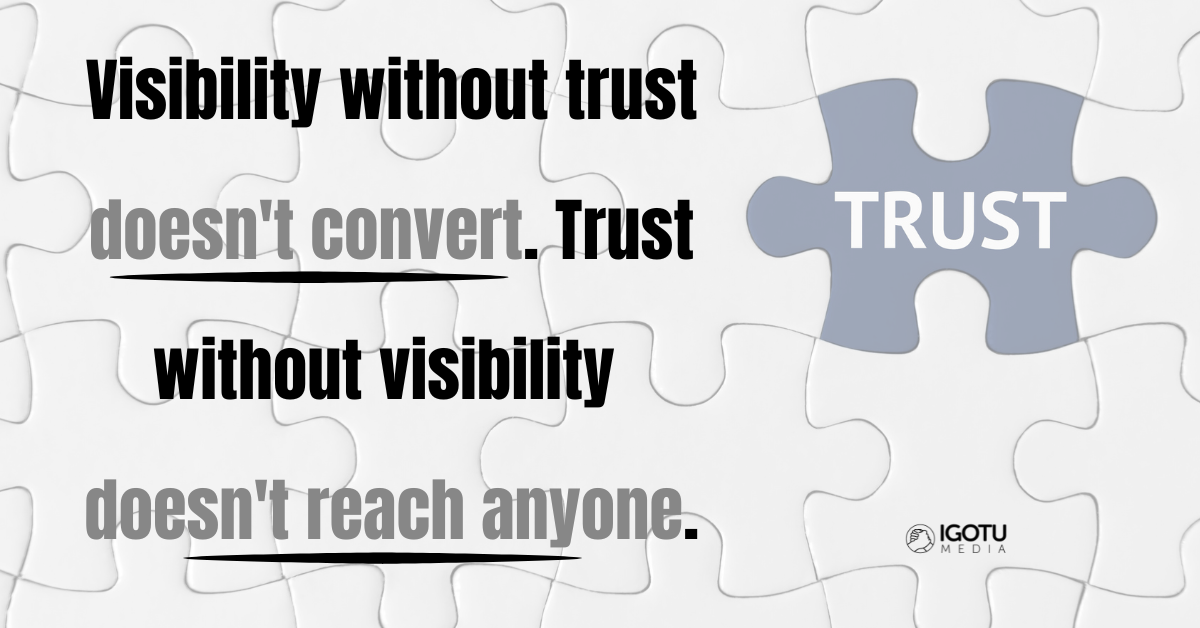
Most agencies pick a lane — they're either a branding agency or an SEO agency. iGotU Media builds both because we know that visibility without trust doesn't convert, and trust without visibility doesn't reach anyone.
Every content piece we build for our clients goes through both lenses:
- Does it target a real search query your customers are using?
- Does it sound like your brand — not generic, not robotic?
- Does it build authority with Google while building connection with people?
- Does it move the reader toward a next step?
The businesses that grow consistently online aren't choosing between brand and SEO. They're doing both — with a system. That's what we build.
See How iGotU Media Builds Content Strategy →

Simple steps. Big results.
Contact Us Form
We will get back to you as soon as possible.
Please try again later.
More Post Like This:



Level Up Your Online Strategy
Whether you're running a service business along the Beeline Highway, trying to get found during tourist season, or just tired of watching competitors outrank you in Show Low or Heber, this is where that changes. Book a free consultation with iGotU Media. No pressure, no jargon, no 90-minute sales pitch. Just an honest conversation about where your business stands and what it would take to get found.