Why Google Reviews Are an SEO Strategy — Not Just a Reputation Tool
Most small business owners think about Google reviews the way they think about a Yelp page — it's where customers say nice things, and more nice things is better. That understanding is incomplete in a way that costs real search visibility. Google reviews aren't just social proof. They're active ranking signals that directly affect whether your business appears in the local pack — the map results that show up above organic search results and capture the majority of clicks for local service searches. Review count, review recency, response rate, and the specific words customers use in their review text are all factors Google's local algorithm measures and weighs. Most small businesses are leaving local pack visibility on the table not because they don't have customers who would leave reviews, but because they don't have a system for generating them consistently. iGotU Media builds the complete local SEO picture for every client — content, Google Business Profile, and review strategy working together. This guide explains what Google actually measures and what to do about it.
Why Google Reviews Are a Ranking Signal — Not Just Social Proof
To understand why reviews matter for SEO, you need to understand how Google decides which businesses to show in the local pack — the three-business map result that appears at the top of local service searches.
Google's three local pack ranking factors:
- Relevance — How well does your business match what the searcher is looking for? This is influenced by your Google Business Profile category, your service descriptions, and the content on your website. A plumber's profile needs to clearly signal "plumbing" through every available field.
- Distance — How close is your business to the searcher or the location they specified? This factor is geographic and largely outside your control beyond confirming your service area is accurately set.
- Prominence — How well-known and authoritative is your business online? This is where reviews enter the ranking equation directly. Prominence is determined by the quantity and quality of information Google can find about your business across the web — and your Google reviews are one of the most significant prominence signals available.
- Where reviews fit into prominence: Google's own documentation states that review count and review score factor into local ranking. A business with more reviews and higher ratings is treated as more prominent — and more prominent businesses rank higher in the local pack for relevant searches. Reviews aren't just visible to potential customers. They're actively influencing which businesses Google decides to show those customers in the first place.
- The implication most businesses miss: Two businesses with identical services, identical locations, and identical website content will rank differently in the local pack if one has a consistent, well-maintained review profile and one doesn't. The business actively generating reviews isn't just building reputation — it's building ranking.
The Four Review Signals Google Actually Measures
Not all review activity is equal. Here are the four specific signals Google's local algorithm evaluates:
1. Review count — the baseline authority signal Total number of Google reviews is the most straightforward prominence signal. More reviews indicate more customers have engaged with your business — which Google interprets as an authority indicator. There's no magic number that unlocks ranking, but consistent comparison shows that businesses with stronger local pack performance almost always have significantly higher review counts than their lower-ranking competitors in the same market.
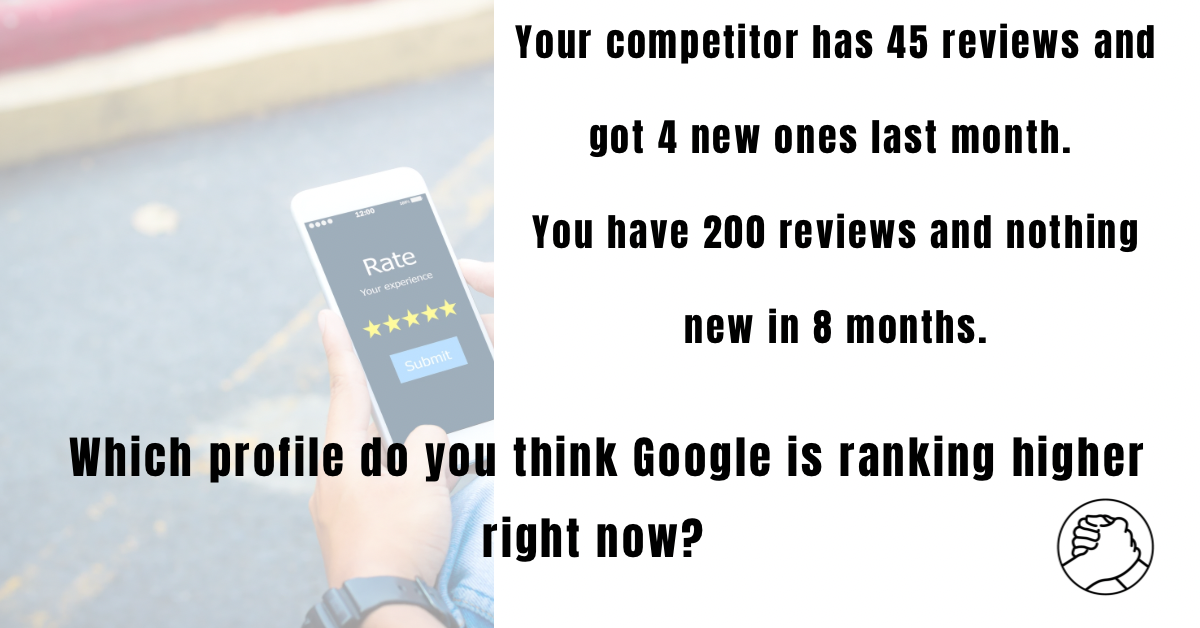
2. Review recency — the active business signal Recent reviews signal that the business is currently active and currently serving customers. A business with 200 reviews and the most recent one from 14 months ago is telling Google that customer engagement has stopped — which is interpreted as a signal that the business may no longer be operating at full capacity or may be less relevant than when those reviews were generated.
3. Response rate and response speed — the engagement signal Google monitors whether business owners respond to reviews — and how quickly. A business that responds to reviews signals active management and customer engagement. A business that hasn't responded to a review in six months signals the same thing as stale review content — reduced activity that affects how Google weights the profile's authority.
4. Keyword content in review text — the relevance signal The actual words customers use in their review text are indexed by Google as relevance signals. When a customer writes "Service Source Plumbing fixed our frozen pipes in Yacolt on the same day we called" — Google indexes "frozen pipes," "Yacolt," and "same day" as service, location, and quality signals for that business. This is review content functioning as user-generated SEO content — something most small businesses don't realize is happening.
Why Review Recency Matters More Than Total Count
This is the insight that changes how most small business owners think about review strategy — and it explains why a newer competitor can outrank an established business with a larger total review count.
The recency decay effect: Google's local algorithm treats review recency as a continuous signal rather than a historical one. Reviews generated in the last 30 to 90 days carry more weight than reviews generated two years ago — regardless of whether the older reviews are positive. A business that generated 200 reviews over five years but hasn't received a new one in eight months has a review profile that's actively decaying in relevance.
The practical comparison:
- Business A: 200 total reviews. Last review 8 months ago. No new reviews since.
- Business B: 45 total reviews. Averages 3 to 4 new reviews per month consistently.
Business B's review profile signals active, ongoing customer engagement. Business A's profile signals historical activity that has stopped. In Google's local ranking logic, recency of activity is a proxy for current relevance — and current relevance is what the local pack is designed to surface.
What this means for review strategy: The goal isn't to generate a large batch of reviews one time and consider the job done. It's to maintain a consistent flow of new reviews that signals ongoing business activity to Google's algorithm. Five new reviews per month consistently over 12 months is more valuable for local ranking than 60 reviews generated in one burst and nothing for the following year.
How Keywords in Review Text Affect Local Rankings
This is the least understood review signal — and one that compounds your local SEO in ways that no other content type can replicate, because it's written by customers rather than by you.
How Google uses review text as relevance data: Google indexes the full text of your Google reviews as part of your business's local relevance profile. When multiple customers mention the same service, location, or problem in their reviews, Google uses that aggregated text as confirmation that your business is relevant for those specific searches.
A concrete example: A plumbing company that receives reviews consistently mentioning "tankless water heater," "Clark County," and "same day service" is building a relevance signal for searches like "tankless water heater service Clark County" and "same day plumber Clark County" — through their customer reviews, not through their service pages alone.
How to encourage specific review content without violating Google's guidelines: Google prohibits incentivizing reviews — you cannot offer discounts, gifts, or any compensation in exchange for a review. What you can do:
- At the completion of a job, ask the customer specifically what service you performed: "If you have a moment to leave us a review, it would mean a lot — feel free to mention what we worked on and where you're located."
- When sending a review request via text or email, reference the specific service: "We hope your [drain cleaning / roof inspection / tree removal] went well. If you're happy with the work, a quick Google review mentioning what we did helps other [city name] homeowners find us."
This approach guides customers toward specific content naturally — it doesn't tell them what to write, it reminds them of the context so they have something specific to write about.
What to avoid:
- Scripted reviews — asking customers to use specific phrases you provide violates Google's guidelines and creates reviews that read as inauthentic
- Review gating — filtering customers by asking them privately if they're happy before directing only positive respondents to Google
- Any form of compensation — discounts, gift cards, or free services in exchange for reviews violate Google's terms and risk profile suspension
Your Review Response Rate Is an SEO Signal Too
Responding to reviews isn't just good customer service — it's active profile management that Google measures.
Why response rate matters to Google: Google's local algorithm interprets review responses as a signal of business engagement and activity. A business that responds to reviews demonstrates active management — which correlates with the business being currently operational, customer-focused, and engaged with its online presence. A business with 80 unanswered reviews and no owner responses signals inactivity in the same way stale review content does.
What your responses should accomplish:
- Confirm the service and location — "Thank you for trusting Swift Roofing with your Royse City roof replacement" reinforces the service and location keywords in the response text, which Google also indexes
- Signal professionalism — future customers read owner responses before calling. A gracious, specific response to a review demonstrates how you handle customer relationships
- Address negative reviews constructively — a thoughtful, non-defensive response to a critical review demonstrates accountability and often matters more to prospective customers than the negative review itself
The response timing signal: Responding to reviews within 24 to 48 hours signals active management more effectively than weekly batch responses. Consistent, timely responses across your review history create a pattern of engagement that strengthens the active business signal.
The practical response framework:
- Thank the customer by referencing the specific service
- Mention the location naturally
- Express genuine appreciation without generic copy-paste language
- For negative reviews — acknowledge the concern specifically, don't dismiss or deflect, invite continued conversation offline
Keep responses under 150 words. Long responses that read as defensive or promotional accomplish the opposite of what a review response should do.
How to Build a Sustainable Review Acquisition System
The difference between businesses with strong review profiles and those with stagnant ones is almost never the quality of their service — it's whether they have a consistent system for asking.
The timing that produces the most reviews: The best moment to ask for a review is immediately after a positive interaction — at job completion when the customer has just experienced the service and satisfaction is highest. This is the moment most businesses miss because no one has made asking part of the standard completion process.
The channels that work: Text message — the highest response rate for review requests. A short text with a direct Google review link sent within an hour of job completion captures the moment when the customer's experience is freshest. Keep it under three sentences. Include the direct link — don't make them search for where to leave the review.
Email — appropriate for customers where phone isn't the primary communication channel. Less immediate than text but effective when the email is brief, personal, and includes a direct link.
In-person ask at job completion — the most effective setup for a text or email follow-up. "I'm going to send you a quick text with a link to our Google page — if you have a minute to leave a review, it helps a lot." This primes the customer to expect and respond to the follow-up.
What not to do:
- Mass blast your entire customer list at once — generates a spike that can trigger Google's spam filters and look suspicious to the algorithm
- Ask repeatedly — one ask at completion, one follow-up within a week if no response. More than that damages the customer relationship
- Use third-party review generation services that automate fake or incentivized reviews — these violate Google's guidelines and risk profile suspension
The system that works:
- Complete the job
- Confirm customer satisfaction in person
- Send a text within 60 minutes with a direct Google review link and a brief, personal ask referencing the specific service
- If no review within 5 to 7 days, one email follow-up
- Log the request so you know who to skip on future service calls
A team that runs this system consistently generates 3 to 8 new reviews per month without pressure, without incentives, and without violating any of Google's guidelines.
How Reviews Connect to Your Overall Local SEO Strategy
Reviews don't operate in isolation — they're one component of a local SEO system where each element reinforces the others:
The complete local visibility system:
- Google Business Profile — the foundation. Your category, service descriptions, service area, hours, and photos establish the baseline relevance and prominence signals. GBP posts signal active business management on a weekly basis.
- Review profile — the ongoing authority signal. Consistent new reviews signal active customer engagement. Review text adds keyword relevance. Response rate signals management engagement. Together these strengthen the prominence factor that determines local pack ranking.
- Blog content cluster — the organic search layer. Your blog content captures the searches that happen before a local pack search — the homeowner researching their problem before they decide to call someone. Content that ranks organically and links to your GBP builds the domain authority that feeds back into local prominence signals.
- How they reinforce each other: A homeowner who finds your business through a blog post on organic search and then sees a strong review profile with recent, specific reviews and consistent owner responses is receiving three separate trust signals simultaneously. The blog earned the initial click. The review profile confirmed the decision. The GBP completed the picture.
This is why iGotU Media builds all three components for every client — because a strong review profile without supporting content, or strong content without review activity, leaves part of the local visibility system incomplete.
For more on how GBP posts fit into this system, read our
Google Business Profile optimization guide →. For the full local pack ranking picture, read our
guide to getting found on Google Maps →.
How iGotU Media Integrates Review Strategy Into Every Client's SEO System
Most content agencies build content. Most reputation management tools manage reviews. iGotU Media builds the system that connects both — because local search visibility is the product of content authority, GBP activity, and review signals working together.
Here's how review strategy integrates into the iGotU system for every client:
Review profile audit When we onboard a new client, we assess the current review profile — total count, recency distribution, response rate, and keyword patterns in review text. This establishes the baseline and identifies the gap between current profile and competitive performance in the local market.
Competitor review benchmarking We look at what the top-ranking businesses in the client's specific local pack are doing with reviews — how many they have, how recently they're generating them, and what keywords appear in their review text.
This tells us what review velocity is needed to be competitive in that specific market.
Review acquisition system design We help clients build the specific ask process — timing, channel, message template, and follow-up sequence — that works for their specific business type and customer relationship model. A roofing company's review ask looks different from a wedding venue's. A plumber's ask at job completion looks different from a lawn care company's seasonal program.
GBP post and content integration Every GBP post we write and every blog we publish is part of a system that supports review generation — because customers who find a business through content are warm to the idea of leaving a review when the service is complete. The content and the review program reinforce each other.
Ongoing monitoring and response guidance We monitor review activity and flag reviews that warrant timely responses — ensuring the response rate signal stays strong and that negative reviews receive the kind of response that protects rather than damages the business's reputation.
The businesses that dominate local pack rankings in their market aren't doing any single thing remarkably well. They're doing content, GBP management, and review generation consistently — and the combination compounds over time in ways that no single element produces alone.
Ready to build a complete local SEO system for your business? Contact iGotU Media to discuss what that looks like for your specific market.
Read: How to Get Your Business Found on Google Maps →
Read: Why Your Google Business Profile Is Your Most Underrated SEO Asset →

Simple steps. Big results.
Contact Us Form
We will get back to you as soon as possible.
Please try again later.
More Post Like This:



Level Up Your Online Strategy
Whether you're running a service business along the Beeline Highway, trying to get found during tourist season, or just tired of watching competitors outrank you in Show Low or Heber, this is where that changes. Book a free consultation with iGotU Media. No pressure, no jargon, no 90-minute sales pitch. Just an honest conversation about where your business stands and what it would take to get found.